Capricorn 01 Zagato: the handcrafted hypercar that defies convention
The launch of the Capricorn 01 Zagato is not just another design exercise in a market saturated with million-euro supercars. It is the first model from a discreet yet essential player in motorsport engineering: Capricorn Group, a nearly century-old German supplier known for ultralight components used in the most demanding racing programmes. By entrusting the design to Zagato, one of Italy’s most selective coachbuilders, Capricorn signals an intention from the outset: to create an “old-school” hypercar — mechanical, analog, and deliberately counter-current to the industry.
But beyond this declared nostalgia, several questions arise. Why would a specialist in advanced materials suddenly decide to build its own car? What strategic purpose does this serve beyond prestige? And does this ultra-limited run of 19 units, priced at €2.95 million before taxes, truly rely on distinctive technical arguments?
Capricorn 01 Zagato: A hypercar shaped by performance rather than excess
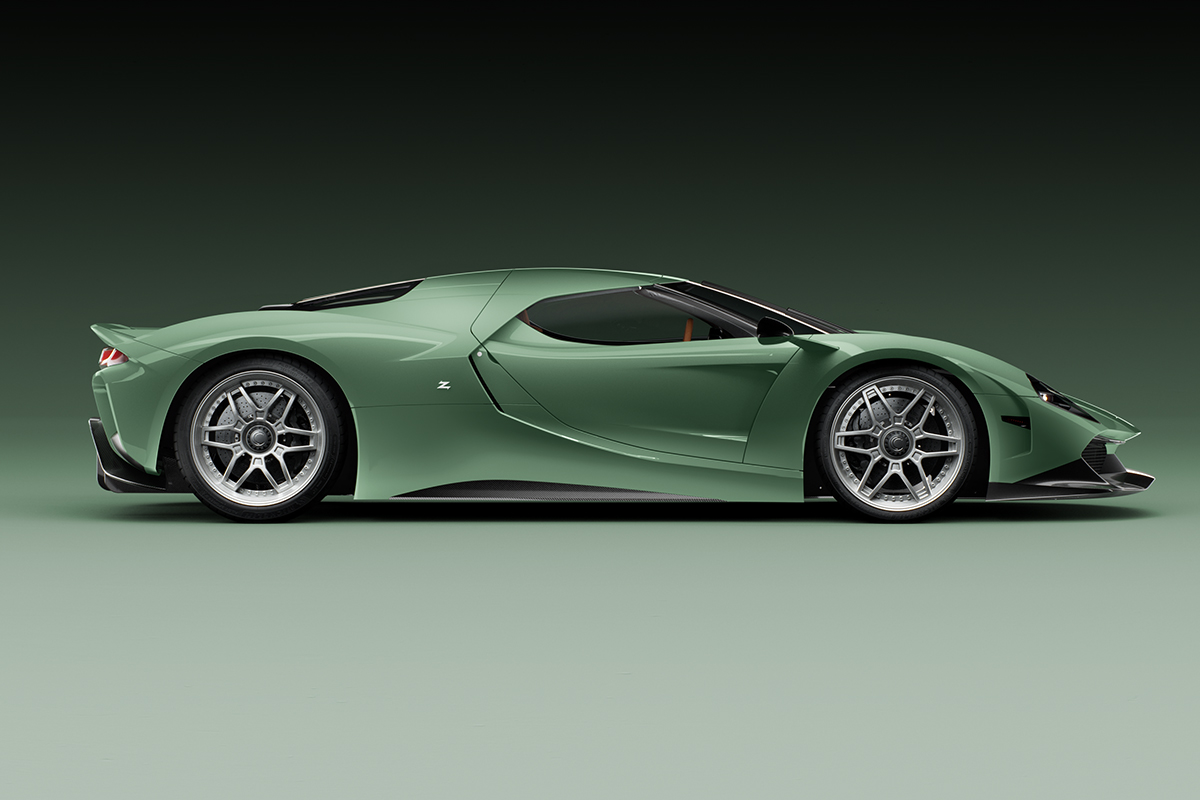
The Capricorn 01 Zagato adopts a deliberately clean silhouette, far removed from the aerodynamic overkill seen on many contemporary hypercars. Yet without a complete technical sheet — no official dimensions have been released — assessing its real positioning is difficult. This lack of transparency is surprising for a brand seeking to appeal to seasoned collectors who are used to scrutinising every detail.
Visually, the body blends recognisable influences:
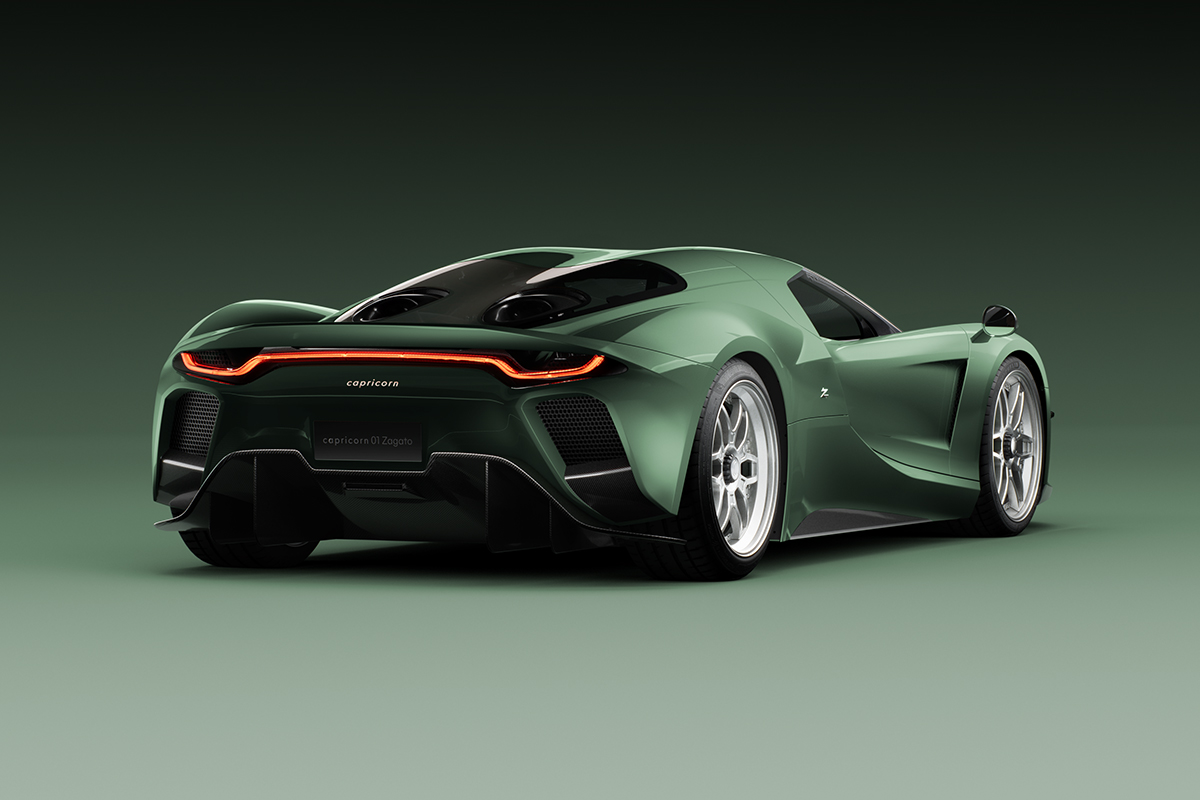
a rear section reminiscent of the Porsche 918, a flowing profile echoing the De Tomaso P72, and an overall presence that recalls the Bugatti Chiron.
Should this be seen as a lack of creative boldness, or as a deliberate effort to align with timeless market codes? Zagato, often more radical, seems here to have opted for a classicist approach.
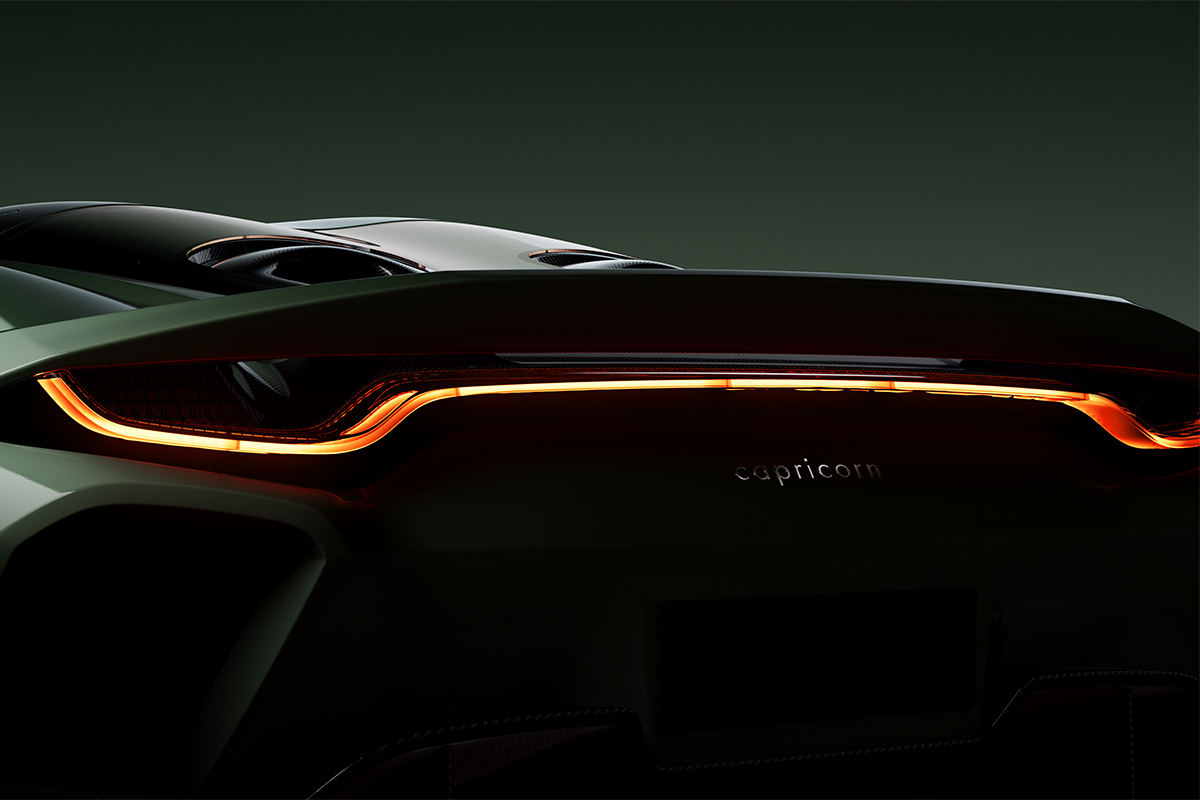
The designer’s signature remains clear: the double roof humps, the generous air intakes, and the large diffuser all reinforce the car’s intent. The 21-inch wheels — aluminium or carbon — complete a design that balances elegance with functional purpose.
Capricorn 01 Zagato: A deliberately minimalist cockpit — but is it enough?
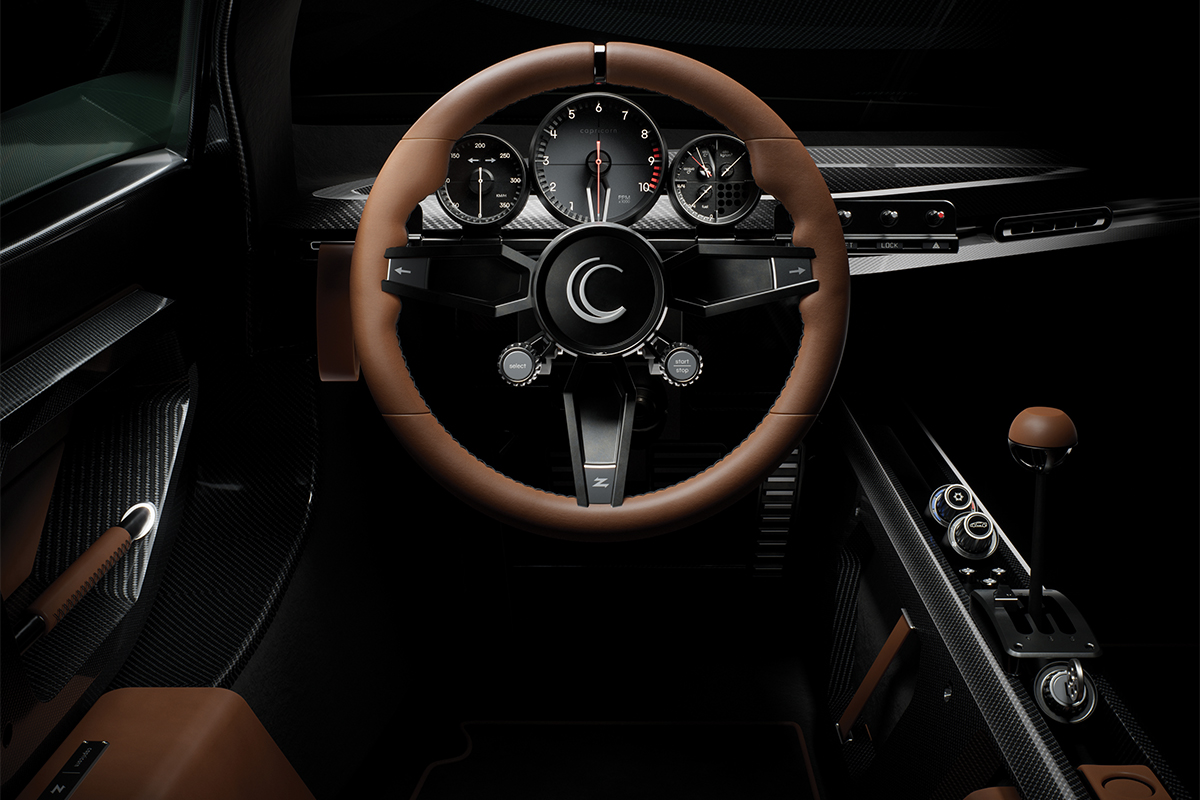
Inside, Capricorn makes an uncommon choice: no screens, no digital interfaces. The dashboard uses traditional analogue gauges, and the five-speed manual gearbox embraces pure mechanical engagement. It is an audacious stance in a market where even the most exclusive models adopt some level of electronic sophistication.
Yet one question persists: can such deliberate minimalism meet the expectations of modern collectors accustomed to analog sensations… but also to advanced technology?
The choice of materials reflects a commitment to craftsmanship: Connolly leather, Alcantara, carbon fibre, titanium, aluminium. The competition-inspired bucket seats with harnesses reinforce the car’s identity as a machine built for driving rather than comfort.
Capricorn 01 Zagato: A heavily reworked V8 with no hybridisation
The engine is the true anomaly in today’s hypercar landscape. The 5.2-litre Ford V8, extensively modified by Capricorn — supercharger, dry sump, pistons, rods, crankshaft — delivers 900 hp and 1,000 Nm, all sent to the rear wheels only.
The absence of any hybrid assistance is a strong statement. But it also raises a strategic question:
is this a purely philosophical stance, or does it reflect a technical limit Capricorn preferred not to address?
With a weight of 1,200 kg, the 01 is exceptionally light for its category thanks to its carbon monocoque, double-wishbone suspension, Bilstein dampers, and carbon-ceramic brakes.
The announced figures follow logically:
0–100 km/h in under 3 seconds
Top speed: 360 km/h
Impressive, though today surpassed in raw numbers by powerful hybrid systems. The Capricorn 01 therefore relies more on mechanical purity than on a horsepower arms race.
Capricorn 01 Zagato: An unclear product strategy with real potential
Orders are expected to open in 2026, via the Louyet Group, and Capricorn suggests that other models are planned. But a critical question remains: does a component supplier truly possess the distribution, after-sales and client-management infrastructure required to support a multi-million-euro hypercar?
History shows that engineering excellence alone is not enough; many technically brilliant players have struggled with the commercial realities of the hypercar market. On the other hand, Capricorn’s expertise in lightweight construction is undeniable, and this 01 may serve as a strategic catalyst for a more ambitious product roadmap.
Capricorn 01 Zagato: A supercar running counter to the wider market
In a landscape dominated by electrification, platform standardisation and increasingly software-centric performance, the Capricorn 01 takes the opposite approach:
a pure combustion engine, a manual gearbox, a minimalist design, and a production run of only 19 units.
This nostalgic positioning could appeal to aesthetes weary of over-assisted hypercars. But the real question is whether this represents a durable industrial vision… or a one-off statement designed to make an impression.